
The Smart Technology Projects That Defined Our 2025 And What They Tell Us About 2026
Every project teaches us something. In 2025, our portfolio taught us that the future of hospitality, real estate, and operations is being shaped less by visible innovation and more by how intelligently assets perform, adapt, and improve over time.
Across different geographies and sectors, one pattern became impossible to ignore:
The most successful projects were not the ones that simply looked impressive at handover, but the ones designed to perform under pressure, integrate intelligently from day one, and create long-term value through data, efficiency, and resilience.
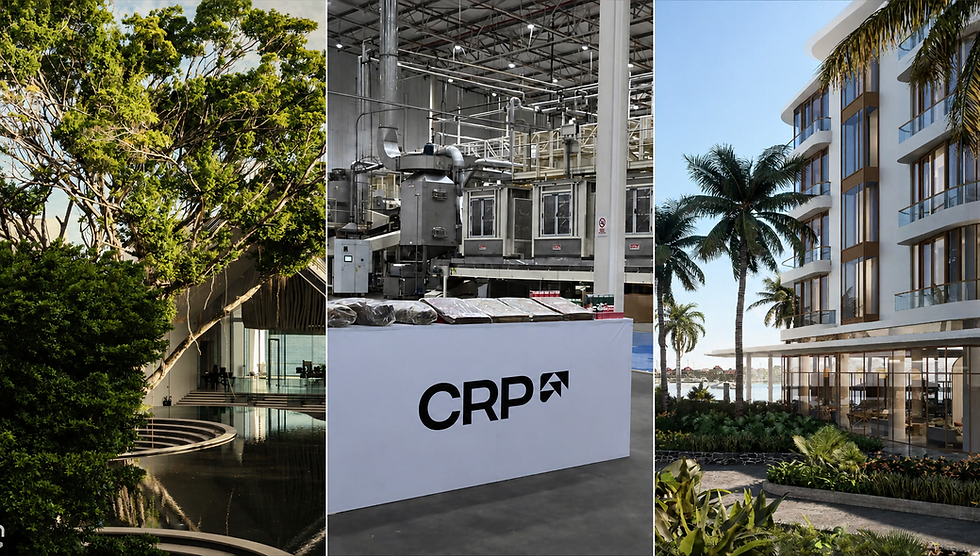
This trajectory emerged clearly in the Seafront Development in Seychelles, Cheval Blanc Seychelles, and the CUT RAG Tobacco Smart Factory in Harare. Each was different in context, yet together they revealed a shared direction: smart infrastructure is no longer optional. It is becoming the foundation of competitive performance.
Smart Technology from Place to Performance
The Seafront Development in Seychelles exemplifies how location alone is no longer enough. A premium coastal site can easily be treated as a design statement, but in reality it presents a complex operational challenge. High humidity, salt exposure, cooling demand, and limited energy supply all shape how an asset must be conceived and delivered.
That is why the most important decision for this project was to embed smart systems early, rather than retrofit them later. Building Management Systems (BMS), advanced HVAC strategies tailored to tropical climates, and granular energy monitoring were integrated into the development process from the outset. The result was not just a “smart-ready” asset, but one designed to be intelligent in its core structure. In environments like the Seychelles, environmental conditions are not constraints to be mitigated—they are the starting point for the design brief. The lesson is clear: climate-responsive, performance-led design is no longer a niche approach. It is becoming the standard.
Invisible Intelligence in Ultra‑Luxury Hospitality
Cheval Blanc Seychelles took that same emphasis on performance and applied it to ultra‑luxury hospitality, where the expectations are even more exacting. In this context, the guest experience should be seamless, intuitive, and uninterrupted. Technology must support that experience without ever becoming the focus.
Behind the calm, curated guest journey sits a highly integrated layer of infrastructure: silent but precise HVAC, lighting and shading systems attuned to ambience and efficiency, hot‑water systems engineered for instant reliability, and discreet automation aligned with guest presence and preferences. The principle is simple: technology should never be seen—but always be felt. In luxury hospitality, failure is always visible, even when the systems themselves are invisible. This project reinforced that in ultra‑high‑end environments, reliability is not a technical detail; it is a brand promise. Performance, consistency, and resilience are what protect revenue and reputation.
Smart Infrastructure Beyond Hospitality
The CUT RAG Tobacco Smart Factory in Harare extended these same principles into an industrial environment, proving that smart infrastructure is not confined to hotels or real estate. In manufacturing, the primary focus shifts from comfort to continuity, but the underlying logic remains the same: data, integration, and predictive operations are what differentiate leading facilities.
At this plant, real‑time monitoring of machinery and production lines, integration of control systems with performance analytics, and centralised dashboards for operational visibility transformed the way the facility was run. Instead of relying on manual checks and reactive maintenance, teams could track equipment performance continuously, identify early warning signs before failures occurred, and schedule maintenance proactively. Energy, too, was treated as a core production variable, not just a cost line. Detailed tracking by process and equipment allowed for targeted optimisation of consumption patterns and load management. The result was reduced downtime, improved throughput, and stronger control over output quality.
This project demonstrated that the line between “smart buildings” and “smart operations” is fading. Whether it is a hotel, a residential development, or a factory, the most valuable assets are those that monitor themselves, learn from data, and continuously improve. In 2025, hospitality and industrial projects alike pointed to the same conclusion:
Intelligence embedded at the system level does not just enhance infrastructure. It transforms business performance.
What Clients Are Really Asking For
By the end of 2025, the conversation with clients had clearly shifted. The question is no longer whether a building or facility should be smart. That has largely been decided. The real questions are now about depth, integration, and longevity.
Clients want smart technology systems that are connected from the beginning, not bolted on later. They want real‑time visibility across assets, predictive maintenance instead of reactive fixes, and energy strategies that support both operational efficiency and financial outcomes. They are also asking for technology that enhances experience without becoming a distraction—especially in hospitality, where simplicity and discretion matter. In short, they are not just buying hardware or software. They are investing in resilience, reliability, and long‑term value.
For properties planning now, this means that retrofitting intelligence is no longer the most effective strategy when performance and scale matter. The strongest assets will be those that bake operational logic into the design phase, not those that layer it on afterwards. Data strategy must sit alongside architectural and engineering strategy. Energy performance is no longer merely an environmental concern; it is a commercial lever. Integration is no longer a technical preference but a competitive necessity. The most forward‑thinking owners, developers, and operators are already planning for assets that can learn, adapt, and improve over time.
What This Means for 2026
If 2025 was about proving what is possible, 2026 is about turning those possibilities into standard practice. The projects that defined our year suggest a future where every major asset is connected, every significant system is measurable, and every operational decision is informed by data rather than assumption.
Predictive infrastructure will continue to replace reactive management. Sustainability and profitability will become increasingly intertwined, not treated as separate agendas. And the key differentiator will be how well an asset performs over time—not just how impressive it looks at handover. The defining advantage will belong to those who can turn performance into a continuous process, not a one‑time achievement.
The clearest lesson from 2025 is that success is no longer defined only by what we build. It is defined by how well it performs after delivery, how intelligently it adapts to changing conditions, and how much value it continues to create over time. The projects that led the way this year have already shown us where 2026 is headed and the direction is clear: from visible innovation to invisible intelligence, from isolated systems to integrated ecosystems, and from static assets to living, learning operations.


Comments